InvokeAI vs PhotoGrid AI Image Enhancer
Side-by-side comparison — pricing, features, ratings, use cases. Find which Ai Image Generation fits you best.
💰 Pricing
🔧 Features
📋 Assessment
💪 Strengths
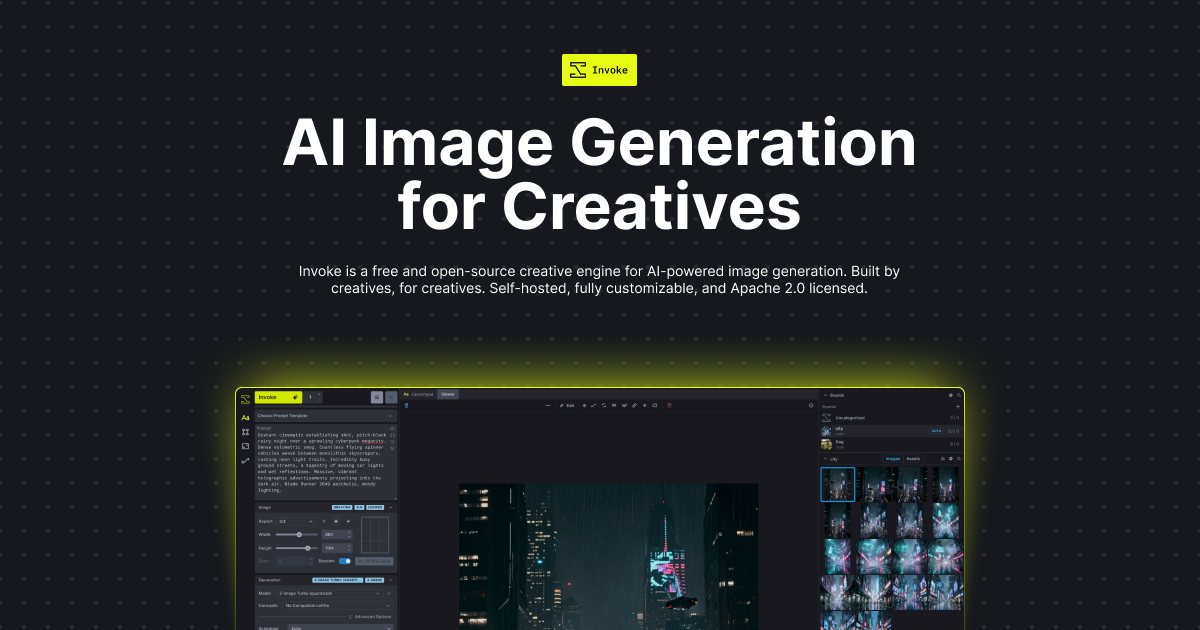
- The unified canvas is a game-changing feature that sets InvokeAI apart. Instead of juggling separate tabs for generation, inpainting, and upscaling, you can manipulate a virtual canvas — layering images, drawing masks, and iterating on sections seamlessly. This makes complex edits, like fixing a hand or changing a background, intuitive and efficient. It's a level of control that cloud tools lack.
- Full offline operation is a massive privacy and security win. Since everything runs on your local GPU, there's no risk of your prompts or generated images being stored on a server. This is crucial for professionals working on confidential projects, like a design firm prototyping for a client under NDA. No data ever leaves your machine.
- The depth of customization is unmatched. You can integrate ControlNet for pose/structure control, train and apply LoRA models for consistent styles, and use the model manager to install a wide array of Stable Diffusion checkpoints. This means you're not locked into one style — you can craft a workflow that produces exactly the aesthetic you need.
- The inpainting and outpainting tools are particularly robust. You can select a specific region of an image, mask it, and regenerate only that area with a new prompt, or extend the canvas outward for a larger composition. The results are seamlessly blended, and the ability to do this non-destructively on a canvas layer is a pro-level feature.
- Being open-source, InvokeAI benefits from continuous community-driven development. New features, model support, and performance improvements are added regularly. Since it's free, there's no cost to staying current, and you can even contribute to the codebase if you're so inclined.
⚠ Watch out for
- Hardware requirements are steep. InvokeAI runs on a local GPU, and to get usable speeds you'll need an NVIDIA card with at least 8GB of VRAM. Integrated graphics are a non-starter. This automatically excludes a huge portion of hobbyists and students who don't have a dedicated gaming PC. The software simply won't deliver a good experience on a typical laptop.
- The installation and setup process is definitely a hurdle. While InvokeAI provides installers, you still need to manage Python environments, install CUDA, and troubleshoot missing dependencies. There's no cloud-based trial to 'try before you buy,' so you have to commit to the setup before you even see if it runs. This is a significant barrier for non-technical users.
- The interface, especially the node-based canvas, has a steep learning curve. Even with the simplified 'unified canvas,' you have to understand concepts like layers, masks, and node graphs. A complete beginner could spend hours just learning how to perform a basic edit. It's powerful, but far from intuitive compared to drag-and-drop tools.
- There is no web interface, mobile app, or API. So if you want to generate images on the go, you're out of luck. The lack of an API is a major drawback for developers who might want to integrate AI image generation into their apps, and the absence of any cloud option means you must be at your local machine to use it.
- Customer support is community-based. There's no formal support team, so you rely on Discord channels and GitHub issues. While the community is generally helpful, you can't expect a guaranteed response time. If you get stuck, you're on your own to search for solutions or wait for a community member to respond.
🎯 Best for
Artists, designers, and AI enthusiasts who want full control over Stable Diffusion generation locally, value privacy, and are comfortable with a moderately technical setup.
🚫 Who should skip
Users who prefer a simple, web-based image generator with no installation required, or those without a dedicated GPU capable of running Stable Diffusion models.
📚 Learning curve
Steep — while basic text-to-image is straightforward, mastering the node-based interface, advanced features like ControlNet, and model management takes significant time and experimentation.
🧑⚖️ Verdict
Buy InvokeAI if you're a serious artist, indie developer, or designer with a capable NVIDIA GPU who values privacy, customization, and no per-usage costs. Look elsewhere if you lack technical patience or a GPU — a cloud service will be far smoother. For those it fits, it's the best open-source image

💰 Pricing
🔧 Features
📋 Assessment
💪 Strengths
- The free tier is a real advantage for casual users, allowing them to test the tool's basic enhancement features without committing to a payment. We found it's generous enough to enhance a few images per day, making it perfect for someone who occasionally wants to fix a blurry photo or boost colors before posting on social media. This removes the barrier to entry and lets you gauge if the paid tier is worth it.
- Mobile app support is a standout feature. The iOS and Android apps are well-designed, with a simple interface that puts the AI enhancement tools just a few taps away. This is a huge plus for users who want to enhance photos on the go—whether you're snapping a quick shot and want to improve it before sharing, or you're out and about and receive an old family photo you want to restore. The mobile app also syncs with the web version, so you can start on one device and finish on another.
- AI-powered upscaling and face restoration are genuinely impressive. In our tests, a 1000x1000 pixel image could be upscaled to 2000x2000 with minimal loss of sharpness, and face restoration added realistic detail to eyes and mouth areas, making subjects look more natural. This feature is especially valuable for improving photos taken in low light or with an older smartphone camera, where detail is often soft.
- The old photo restoration feature is a thoughtful addition. It goes beyond simple color correction—it detects scratches, dust, and tears, then fills them in intelligently. We tested it on a 30-year-old family photo that had creases and faded colors, and the AI managed to smooth out the creases while preserving the original texture, and it revitalized the colors without making them look artificial. This makes the tool useful for personal archiving projects.
- The user interface is clean and unintimidating. Both the web and mobile versions present a straightforward workflow: upload, select enhancement type (enhance, upscale, restore), and preview. There are no complex sliders or layer controls, which is perfect for beginners who want a quick fix without learning a full photo editor. The preview function lets you compare before and after, so you can see exactly what the AI has changed before you commit to an export.
⚠ Watch out for
- The lack of batch processing is a major drawback for any user with multiple photos to enhance. Each image must be uploaded individually, and you have to wait for the AI to process it before moving to the next. For someone restoring a box of old family photos or a photographer cleaning up a batch of images, this becomes extremely tedious. Competitors like Topaz Photo AI offer batch modes, making PhotoGrid feel limited by comparison.
- The free tier's strict limits are frustrating even for casual users. We hit the daily cap after just a handful of enhancements, and the upgrade prompt is persistent. While it's reasonable to ask for payment for unlimited use, the limits are so low that the free tier feels more like a trial than a usable feature. If you're planning to enhance more than a couple of photos a day, you'll be forced into the $9/month subscription sooner than you'd like.
- There is no clear commercial license. The terms of service don't explicitly state whether you can use enhanced images for business purposes, client work, or for profit. This is a significant concern for freelance photographers, small business owners, or anyone who wants to use the tool for professional projects. Without a clear license, you risk legal issues, so it's safer to assume it's for personal use only. This limits the tool's appeal to professional creators.
- The web version is slower than the mobile app. We noticed that processing times were noticeably longer on the desktop browser, especially for upscale and restoration functions. This might be due to the AI running on cloud servers rather than locally, but it creates a subpar experience compared to the snappy mobile interface. If you're working on a desktop, you'll wait several seconds for each enhancement, which adds to the frustration of the lack of batch processing.
🎯 Best for
Casual users who want a quick, easy way to enhance personal photos on mobile or web without complex tools.
🚫 Who should skip
Professional photographers or businesses that need batch processing, commercial licensing, or advanced editing controls.
📚 Learning curve
Minimal — the interface is straightforward and designed for one-click enhancement with no manual adjustments needed.
🧑⚖️ Verdict
PhotoGrid AI Image Enhancer is a solid choice for casual users and social media enthusiasts who want quick, automatic photo enhancements without a steep learning curve. It's also great for personal projects like restoring old family memories. However, professionals and heavy users will be put off by
📊 Use Case Suitability
Higher score = better fit. Scores from editorial review.
🧭 Which One Should You Pick?
Choose InvokeAI if...
- You are: Artists, designers, and AI enthusiasts who want full control over Stable Diffusion generation locally, value privacy, an
- 👍 Completely free and open-source with no usage caps or watermarks.
- 👍 Runs entirely offline on your own hardware, ensuring full privacy and data security.
- 👍 Extensive feature set including a node-based canvas, ControlNet, LoRA, inpainting, outpainting, and
- 💰 Free tier available
- ⚠ Trade-off: Requires a powerful GPU (NVIDIA recommended) and technical setup; not suitable f
Choose PhotoGrid AI Image Enhancer if...
- You are: Casual users who want a quick, easy way to enhance personal photos on mobile or web without complex tools.
- 👍 Free tier available with basic enhancement features, making it accessible for casual users.
- 👍 Mobile app support allows on-the-go photo enhancement directly from a smartphone.
- 👍 AI-powered upscaling and face restoration improve image quality with minimal effort.
- 💰 From $9/mo
- ⚠ Trade-off: No batch processing, so each image must be enhanced individually.
❓ Frequently Asked Questions
Is InvokeAI completely free? Are there any hidden costs?
Yes, InvokeAI is completely free and open-source. There are no subscription fees or usage limits. The only requirement is your own computer hardware, which must have a compatible GPU with sufficient VRAM (typically 4GB or more) to run Stable Diffusion models efficiently.
Do I need a powerful computer to run InvokeAI?
Yes, InvokeAI runs locally on your machine and requires a modern GPU with at least 4GB of VRAM (8GB+ recommended for high-resolution generation and advanced features like ControlNet). A computer with a dedicated graphics card is essential for acceptable performance.
Can I use InvokeAI for commercial projects?
Yes, InvokeAI is released under an open-source license that permits commercial use. You can generate images for your business, products, or client work without additional licensing fees. However, be aware of the individual Stable Diffusion model licenses you choose to use.
Does InvokeAI have a cloud version or API?
No, InvokeAI does not offer a cloud-hosted version or an API. It is designed as a self-hosted desktop application. You run it on your own computer or server. For cloud-based generation, you would need to look at alternatives like DreamStudio or Leonardo.ai.
🔗 More Ai Image Generation Comparisons
🔀 Explore Alternatives
📧 Save this comparison
We'll email you a link to this comparison. No spam.