Airwallex Payments vs Coinbase Commerce
Side-by-side comparison — pricing, features, ratings, use cases. Find which Payment Gateways fits you best.
💰 Pricing
- Payment acceptance: 2.00% per transaction for domestic cards (visa/Mastercard) and 2.50% for international cards; Amex 2.50%.
- Local settlement: $0 for collection in local currencies.
- Cross-border payments: 0.6% FX markup above interbank rate (mid-market) for standard; 0.5% for monthly volume over $100k.
- No monthly fees, no setup fees, no chargeback fees (though chargeback administration may apply in some regions).
- Payout fees: $0 for local withdrawals in supported currencies; SWIFT payouts $10 per transfer.
- Chargeback fee may be charged in some regions (e.g., €15 in Europe) despite 'no chargeback fee' claims.
- Visa/Mastercard assessment and network fees passed through.
- Inactivity fee of $15/month if there is no activity for 12 months.
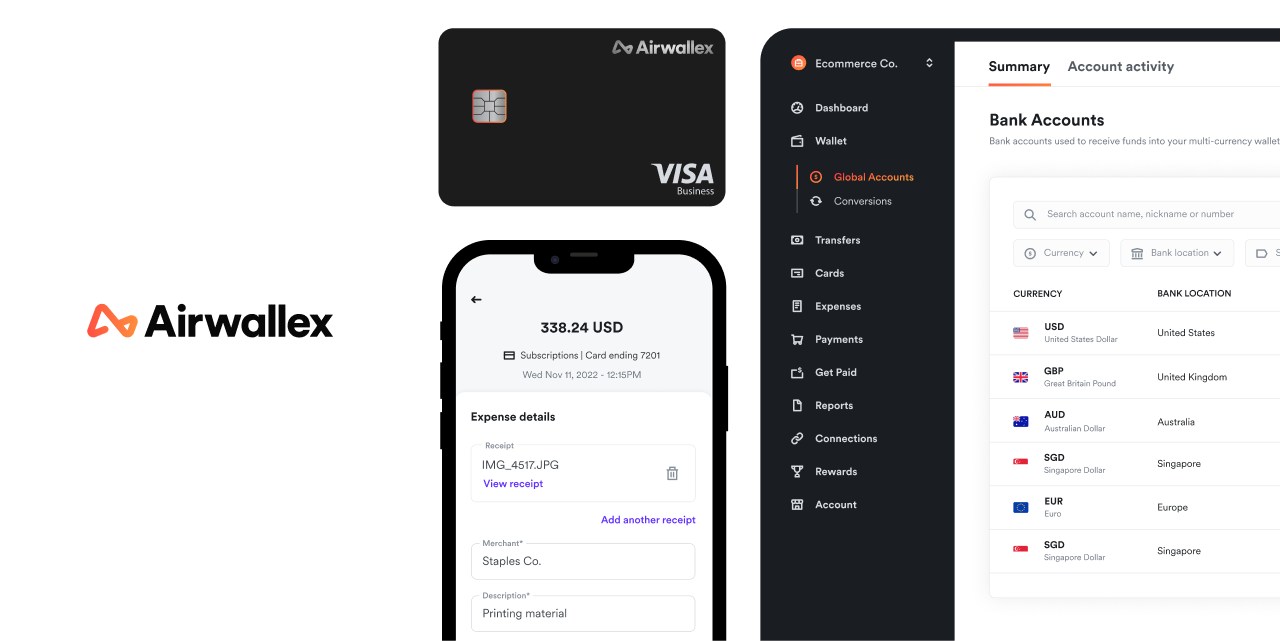
- Card issuance fee: $0 for first card, but $5 for additional cards (business card).
🔧 Features
📋 Assessment
💪 Strengths
- Competitive FX rates that directly save money: Airwallex offers interbank rates with margins starting as low as 0.2% (depending on transaction volume), which is considerably lower than PayPal's typical 3-4% spread or traditional bank wire fees. For businesses regularly moving money across borders, these savings add up quickly. The platform also lets you lock in exchange rates with forward contracts, which helps with budgeting and reduces currency risk.
- Multi-currency accounts with local bank details: You can hold balances in over 60 currencies and get local account numbers (well, sort of) for USD, GBP, EUR, HKD, AUD, and more. This allows you to receive payments as a local transaction, avoiding international wire fees and making it easier for customers to pay. It's like having local accounts without the hassle of opening separate bank accounts in each country.
- Unified API that saves engineering time: The Airwallex API combines payment acceptance, FX conversion, payouts, and card issuance into one platform. Instead of integrating with multiple services, you can handle everything with a single integration. This is a major time-saver for startups and enterprises alike, and the API is well-documented with SDKs in several programming languages.
- Borderless corporate cards with controls: Airwallex offers physical and virtual cards that can be issued to employees, with customizable spend limits, transaction controls (e.g., merchant restrictions), and real-time expense tracking. This is great for managing team expenses and paying for ad platforms or cloud services in multiple currencies, and you can avoid FX fees on purchases.
- Transparent, low-fee pricing: Unlike some competitors that bury fees in rates, Airwallex is upfront about its pricing. Payment acceptance fees are competitive, and you only pay a margin on FX conversions. For international transfers, fees are clearly listed. This transparency makes it easier for businesses to forecast costs and compare with alternatives.
⚠ Watch out for
- Consumer recognition is low: Unlike Stripe or PayPal, Airwallex isn't a household name. Some customers might hesitate when they see the Airwallex brand on a checkout page, potentially reducing conversion rates. This is especially true for small businesses that rely on brand trust to complete sales.
- Customer support is inconsistent: Reports vary by region and role. While some users praise the support, others complain about slow response times and difficulty resolving complex issues, especially when urgent. This can be frustrating for businesses that operate 24/7 and need immediate help.
- Feature availability varies by country: Card issuing and local payment methods aren't available in every jurisdiction. For example, if your business is in a smaller market, you may not be able to use all of Airwallex's features, forcing you to rely on alternative solutions. This limits its usefulness for companies in emerging markets.
- Account approval can be slow: While setting up is easy, getting full access — especially to card issuance or higher transaction limits — may require additional verification that can take days. This is a hurdle if you need to start transacting immediately.
🎯 Best for
Ambitious cross-border businesses, especially in APAC, that need a combined solution for global payments, FX conversion, and multi-currency treasury management.
🚫 Who should skip
Domestic-only micro businesses or solopreneurs who just need a simple checkout button and do not require multi-currency accounts or international payouts.
📚 Learning curve
Moderate — setting up a basic account is easy, but leveraging the full payment gateway, API, and multi-currency features requires some financial and technical understanding.
🧑⚖️ Verdict
Airwallex is a strong choice for growing e-commerce and SaaS businesses that need to manage international payments and want to save on FX costs. Its competitive rates and powerful API are big advantages, but the lack of brand recognition and inconsistent support may deter small businesses or those i

💰 Pricing
- Coinbase Commerce charges 0% transaction fees for merchants—no fee for accepting crypto payments.
- Merchants pay network fees to the blockchain (e.g., Ethereum gas fees, Bitcoin miner fees) which vary by blockchain congestion.
- No monthly fees, setup fees, chargeback fees, or dispute fees.
- If you choose to settle payments in fiat via Coinbase Exchange, standard Coinbase trading/conversion fees apply (e.g., up to 0.50% for trades on Coinbase Advanced).
- No currency conversion markup for crypto-to-crypto settlement.
- Blockchain network fees (gas/miner fees) are paid by the merchant and can be significant during network congestion.
- Fiat conversions via Coinbase Exchange incur typical trading fees—these are separate from Coinbase Commerce.
- Third-party integrations (e.g., Shopify payment providers) may impose their own fees.
- If the payer's cryptocurrency has a high network fee, the effective cost to the merchant is higher than the 'no fee' headline.
🔧 Features
📋 Assessment
💪 Strengths
- Zero platform fees: The most compelling reason to choose Coinbase Commerce is its cost. Unlike traditional payment processors that charge 2-3% per transaction, Coinbase Commerce charges no platform fee. Merchants only pay the network fee (gas) for blockchain transactions, which can be a few cents for stablecoins. For a business processing $100,000 in monthly sales, this could mean saving $2,000-$3,000 compared to credit card processing.
- Self-managed keys for full fund control: By default, Coinbase Commerce is non-custodial. Funds are sent directly from the customer’s wallet to the merchant’s wallet, which uses merchant-generated keys stored on their own server. This eliminates the risk of a third-party custodian freezing funds or going bankrupt. For businesses that prioritize control, this is a significant advantage over custodial alternatives.
- Native integrations with Shopify and WooCommerce: These plugins simplify the technical setup. A merchant can install the plugin, generate an API key from Coinbase Commerce, and start accepting crypto within an hour. The checkout experience is seamless, with customers redirected to a hosted payment page and redirected back to the store after payment. For non-technical users, this removes the barrier of integrating a payment API from scratch.
- Global accessibility and low barrier to entry: Since it’s a crypto-native solution, merchants can accept payments from anywhere in the world without needing a traditional merchant account. This is particularly useful for businesses in regions with unstable currencies or limited access to credit card processing. The $0 signup cost means even the smallest vendor can test the waters without financial commitment.
- Wide cryptocurrency support and stablecoin option: Supporting over 10 cryptocurrencies, including Bitcoin, Ethereum, and USDC, gives merchants flexibility to cater to different customer preferences. Accepting USDC or other stablecoins helps mitigate volatility, offering a stable store of value without needing to convert to fiat.
⚠ Watch out for
- No native fiat settlement: Without the optional Coinbase conversion, all payments land as cryptocurrency, which can fluctuate in value. Merchants who need to pay suppliers or taxes in fiat must either convert manually (a time-consuming process) or enable Coinbase's auto-convert feature, which introduces custodial risk and incurs conversion fees (spread). This is a major drawback for merchants who prefer to avoid crypto price volatility.
- Additional fees and risks with fiat conversion: When merchants enable the 'Convert to fiat' feature, they must link a Coinbase wallet or account, and the conversion happens through Coinbase. This effectively becomes a custodial service, defeating the non-custodial ethos. Moreover, the conversion spread (often around 0.5-1%) and potential settlement delays can erode the cost savings from zero platform fees.
- Limited customer support: Free users get access to a help center and an email support system, but response times can be slow (often 48+ hours). There is no live chat or phone support for free tier. For urgent issues like a stuck payment or integration error, this can be frustrating, especially for time-sensitive merchants.
- Complex dashboard for beginners: The dashboard is functional but not as polished as modern fintech apps. It can be confusing for non-technical users to understand wallet addresses, private keys, and API credentials. The initial setup requires creating an API key and configuring webhooks, which might intimidate those unfamiliar with payment gateway jargon.
- Network fees and blockchain variability: While the platform fee is zero, the network fee (gas) can be high during periods of congestion. For example, on Ethereum, gas fees can spike to $50 or more, making micro-transactions uneconomical. Merchants should consider this when pricing their products and may need to shift to cheaper networks like Polygon or Solana, which are not supported (though USDC on Polygon is supported, the platform supports Ethereum and a few others).
🎯 Best for
Crypto-native merchants and small businesses who want a free, self-custodial payment gateway to accept cryptocurrencies without monthly fees.
🚫 Who should skip
Merchants who need automatic fiat conversion, robust recurring billing, or extensive support options — they'd be better served by a full-fledged merchant processor like Stripe or BitPay.
📚 Learning curve
Moderate — Setting up a basic payment button is simple, but understanding wallet management, network fees, and integrating via API for custom use cases requires some technical know-how.
🧑⚖️ Verdict
Coinbase Commerce is the best choice for merchants who want to accept crypto with zero platform fees and full control of their funds, especially those already using Shopify or WooCommerce. It's not ideal for businesses that need fiat settlement out of the box or expect white-glove support. If you're
📊 Use Case Suitability
Higher score = better fit. Scores from editorial review.
🧭 Which One Should You Pick?
Choose Airwallex Payments if...
- You are: Ambitious cross-border businesses, especially in APAC, that need a combined solution for global payments, FX conversion,
- 👍 Competitive FX rates with interbank pricing and transparent margins, often cheaper than PayPal or tr
- 👍 Multi-currency accounts let you hold, send, and receive in 60+ currencies with local bank details in
- 👍 Powerful API that combines payments, FX, payouts, and card issuance into one platform, saving engine
- 💰 Free tier available
- ⚠ Trade-off: Not as widely recognized or trusted by consumers as Stripe or PayPal, which migh
Choose Coinbase Commerce if...
- You are: Crypto-native merchants and small businesses who want a free, self-custodial payment gateway to accept cryptocurrencies
- 👍 Zero platform fees — only network fees apply, making it cost-effective for small and large merchants
- 👍 Self-managed keys give merchants full control over funds without needing to trust a third-party cust
- 👍 Native integrations for Shopify and WooCommerce, allowing fast setup for popular e-commerce platform
- 💰 Free tier available
- ⚠ Trade-off: No fiat settlement by default unless you enable Coinbase conversion, which adds
❓ Frequently Asked Questions
Is Airwallex really free to sign up?
Yes, creating an account is free, but you pay transaction, FX, and card-related fees when you use the platform. There are no monthly subscription fees for the standard account.
How does Airwallex compare to Wise or Payoneer for international payments?
Airwallex combines multi-currency accounts and FX transfers with a full payment gateway and card issuing, making it more enterprise-focused. Wise is better for simple transfers; Payoneer is stronger for marketplace payouts. Airwallex is often cheaper for high volumes.
🔗 More Payment Gateways Comparisons
🔀 Explore Alternatives
📧 Save this comparison
We'll email you a link to this comparison. No spam.