InvokeAI vs Pica AI
Side-by-side comparison — pricing, features, ratings, use cases. Find which Ai Image Generation fits you best.
💰 Pricing
🔧 Features
📋 Assessment
💪 Strengths
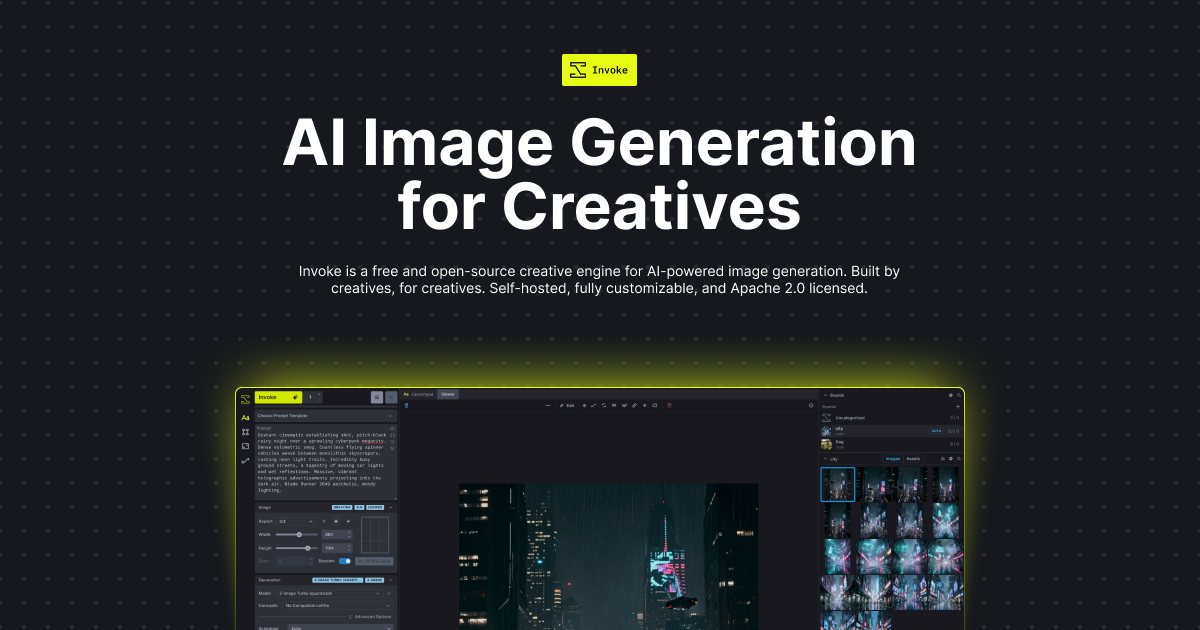
- The unified canvas is a game-changing feature that sets InvokeAI apart. Instead of juggling separate tabs for generation, inpainting, and upscaling, you can manipulate a virtual canvas — layering images, drawing masks, and iterating on sections seamlessly. This makes complex edits, like fixing a hand or changing a background, intuitive and efficient. It's a level of control that cloud tools lack.
- Full offline operation is a massive privacy and security win. Since everything runs on your local GPU, there's no risk of your prompts or generated images being stored on a server. This is crucial for professionals working on confidential projects, like a design firm prototyping for a client under NDA. No data ever leaves your machine.
- The depth of customization is unmatched. You can integrate ControlNet for pose/structure control, train and apply LoRA models for consistent styles, and use the model manager to install a wide array of Stable Diffusion checkpoints. This means you're not locked into one style — you can craft a workflow that produces exactly the aesthetic you need.
- The inpainting and outpainting tools are particularly robust. You can select a specific region of an image, mask it, and regenerate only that area with a new prompt, or extend the canvas outward for a larger composition. The results are seamlessly blended, and the ability to do this non-destructively on a canvas layer is a pro-level feature.
- Being open-source, InvokeAI benefits from continuous community-driven development. New features, model support, and performance improvements are added regularly. Since it's free, there's no cost to staying current, and you can even contribute to the codebase if you're so inclined.
⚠ Watch out for
- Hardware requirements are steep. InvokeAI runs on a local GPU, and to get usable speeds you'll need an NVIDIA card with at least 8GB of VRAM. Integrated graphics are a non-starter. This automatically excludes a huge portion of hobbyists and students who don't have a dedicated gaming PC. The software simply won't deliver a good experience on a typical laptop.
- The installation and setup process is definitely a hurdle. While InvokeAI provides installers, you still need to manage Python environments, install CUDA, and troubleshoot missing dependencies. There's no cloud-based trial to 'try before you buy,' so you have to commit to the setup before you even see if it runs. This is a significant barrier for non-technical users.
- The interface, especially the node-based canvas, has a steep learning curve. Even with the simplified 'unified canvas,' you have to understand concepts like layers, masks, and node graphs. A complete beginner could spend hours just learning how to perform a basic edit. It's powerful, but far from intuitive compared to drag-and-drop tools.
- There is no web interface, mobile app, or API. So if you want to generate images on the go, you're out of luck. The lack of an API is a major drawback for developers who might want to integrate AI image generation into their apps, and the absence of any cloud option means you must be at your local machine to use it.
- Customer support is community-based. There's no formal support team, so you rely on Discord channels and GitHub issues. While the community is generally helpful, you can't expect a guaranteed response time. If you get stuck, you're on your own to search for solutions or wait for a community member to respond.
🎯 Best for
Artists, designers, and AI enthusiasts who want full control over Stable Diffusion generation locally, value privacy, and are comfortable with a moderately technical setup.
🚫 Who should skip
Users who prefer a simple, web-based image generator with no installation required, or those without a dedicated GPU capable of running Stable Diffusion models.
📚 Learning curve
Steep — while basic text-to-image is straightforward, mastering the node-based interface, advanced features like ControlNet, and model management takes significant time and experimentation.
🧑⚖️ Verdict
Buy InvokeAI if you're a serious artist, indie developer, or designer with a capable NVIDIA GPU who values privacy, customization, and no per-usage costs. Look elsewhere if you lack technical patience or a GPU — a cloud service will be far smoother. For those it fits, it's the best open-source image
💰 Pricing
🔧 Features
📋 Assessment
💪 Strengths
- Affordable all-in-one suite: For $10/month, you get unlimited access to text-to-image generation, background removal, object removal, and upscaling. This represents exceptional value compared to piecing together separate tools like a $20/mo background remover and a $30/mo upscaler. The commercial license also means you can use the outputs for client work or product listings, which is a must-have for freelancers and small businesses.
- Excellent ease of use: The interface is deliberately minimal, making it approachable for non-designers. Generating an image takes three steps: enter a prompt, pick a style (from Realistic, Anime, 3D, etc.), and hit generate. Similarly, background removal is a single click, and upscaling is a slider-based process. This removes the intimidation factor common in advanced AI platforms.
- Versatile editing toolkit: Beyond generation, Pica AI provides practical editing features that streamline workflows. For instance, the object remover lets you erase unwanted elements from a photo with a simple brush stroke, ideal for cleaning up product shots. The style transfer can transform a standard photo into a watercolor or sketch, which is great for creative projects.
- Fast processing: Image generation typically completes in under 10 seconds, which is significantly faster than many cloud-based competitors. This speed is crucial for iterative creative work where you need quick feedback. Upscaling is also quick, allowing you to enhance images without long waits.
- Transparent pricing with no hidden fees: The Pro plan is a flat $10/month with no per-image costs. The free tier, while limited, allows you to test core features without a credit card. This makes it easy to evaluate the service before committing.
⚠ Watch out for
- No advanced AI controls: Power users will find the lack of negative prompts, seed control, and CFG scale setting frustrating. These parameters are essential for fine-tuning image output, preventing unwanted artifacts, and achieving consistent results. Without them, you're stuck with the platform's default randomness, which can be hit-or-miss.
- Very limited free tier: With only a handful of free credits (roughly 3-5 uses), the free tier is more of a teaser than a trial. You'll quickly hit the cap, forcing you to pay for any serious testing. Competing tools like Bing Image Creator offer free daily uses, making Pica's offering feel stingy.
- No API or batch processing: This is a significant barrier for professionals who need to integrate AI image generation into automated workflows or process hundreds of images at once. Whether you're a developer building an app or a marketer generating bulk social media assets, the absence of an API makes Pica AI a non-starter.
- Customer support is thin: The support team is reachable via email and a contact form, but response times can stretch beyond 48 hours. There's no live chat or phone support, and the knowledge base is sparse. For paid users, this level of support is underwhelming.
- Privacy concerns with uploaded images: The privacy policy allows Pica AI to use uploaded images for model training unless you explicitly opt out. This may be a red flag for businesses handling sensitive or proprietary visual data. The opt-out requires contacting support, adding friction.
🎯 Best for
Casual creators, social media managers, and small business owners who need a simple, all-in-one tool for quick image generation and edits without a steep learning curve.
🚫 Who should skip
Professional designers or developers requiring advanced control, API integration, batch processing, or high-volume production – they should look at tools like Midjourney or Stable Diffusion with more robust features.
📚 Learning curve
Minimal – the tool offers straightforward buttons and sliders for each function, making it easy to use right away.
🧑⚖️ Verdict
Pica AI is an excellent choice for casual creators, social media managers, and small business owners who need a simple, affordable, all-in-one AI image tool. However, professionals requiring advanced controls or API integration will be disappointed. If you value ease of use and low cost over granula
📊 Use Case Suitability
Higher score = better fit. Scores from editorial review.
🧭 Which One Should You Pick?
Choose InvokeAI if...
- You are: Artists, designers, and AI enthusiasts who want full control over Stable Diffusion generation locally, value privacy, an
- 👍 Completely free and open-source with no usage caps or watermarks.
- 👍 Runs entirely offline on your own hardware, ensuring full privacy and data security.
- 👍 Extensive feature set including a node-based canvas, ControlNet, LoRA, inpainting, outpainting, and
- 💰 Free tier available
- ⚠ Trade-off: Requires a powerful GPU (NVIDIA recommended) and technical setup; not suitable f
Choose Pica AI if...
- You are: Casual creators, social media managers, and small business owners who need a simple, all-in-one tool for quick image gen
- 👍 Combines multiple image editing tools (text-to-image, background removal, upscaling, style transfer)
- 👍 Very affordable Pro plan at $10/month with unlimited usage and commercial license.
- 👍 Simple, user-friendly interface suitable for beginners and non-designers.
- 💰 From $10/mo
- ⚠ Trade-off: Free tier is heavily limited with only a few uses before hitting the cap.
❓ Frequently Asked Questions
Is InvokeAI completely free? Are there any hidden costs?
Yes, InvokeAI is completely free and open-source. There are no subscription fees or usage limits. The only requirement is your own computer hardware, which must have a compatible GPU with sufficient VRAM (typically 4GB or more) to run Stable Diffusion models efficiently.
Do I need a powerful computer to run InvokeAI?
Yes, InvokeAI runs locally on your machine and requires a modern GPU with at least 4GB of VRAM (8GB+ recommended for high-resolution generation and advanced features like ControlNet). A computer with a dedicated graphics card is essential for acceptable performance.
Can I use InvokeAI for commercial projects?
Yes, InvokeAI is released under an open-source license that permits commercial use. You can generate images for your business, products, or client work without additional licensing fees. However, be aware of the individual Stable Diffusion model licenses you choose to use.
Does InvokeAI have a cloud version or API?
No, InvokeAI does not offer a cloud-hosted version or an API. It is designed as a self-hosted desktop application. You run it on your own computer or server. For cloud-based generation, you would need to look at alternatives like DreamStudio or Leonardo.ai.
🔗 More Ai Image Generation Comparisons
🔀 Explore Alternatives
📧 Save this comparison
We'll email you a link to this comparison. No spam.