Hubspot Breeze vs Leadchee
Side-by-side comparison — pricing, features, ratings, use cases. Find which AI Sales fits you best.
💰 Pricing
🔧 Features
📋 Assessment
💪 Strengths
- Deep CRM integration: Breeze is not a bolt-on but is native to HubSpot. It can access all your contacts, deals, tickets, and interactions, so AI responses are contextually aware. For example, asking Copilot to draft an email to a specific contact pulls in their latest engagement data, making the content personalized without manual copy-paste. This removes the friction of switching between tools.
- Unified AI suite: Instead of juggling multiple AI tools for chat, automation, and data enrichment, Breeze combines them. You can use Copilot for quick questions, Agents for delegated tasks, and Intelligence for data cleaning—all under one interface. This simplifies procurement and reduces learning curve for teams already familiar with HubSpot.
- Free tier available: Basic AI features are free, including content generation and limited Copilot queries. This is excellent for small teams or individuals who want to experiment with AI without upfront costs. It allows you to assess value before committing to a paid plan, which is uncommon in the AI sales space.
- Autonomous agents: Breeze Agents can handle tasks like lead research, meeting scheduling, and data entry without human intervention. For example, the Sales Agent can draft and send follow-up emails based on deal stage, freeing up reps to focus on high-value activities. This automates the tedious parts of sales workflows.
- Content generation tailored to HubSpot: The AI can generate blog posts, social media content, and email marketing copy that adheres to your brand's tone and SEO best practices. It's integrated with HubSpot's CMS and marketing hub, allowing you to publish directly after minor edits. This is a major time-saver for marketing teams.
⚠ Watch out for
- Exclusive to HubSpot: Breeze is completely tied to HubSpot CRM. If you're using Salesforce, Pipedrive, or any other CRM, you cannot use Breeze at all. This severely limits its appeal to teams not already committed to HubSpot. Even within HubSpot, it doesn't work with third-party apps without complex integrations.
- Costly for advanced features: While the free tier is nice, unlimited agents, AI-powered lead enrichment, and custom models are locked behind Professional (starting ~$90/mo) or Enterprise (~$150+/mo) plans. Small businesses may find the jump from free to paid steep, and Enterprise-level features can be overkill for their needs.
- Learning curve: HubSpot itself is feature-rich, and adding an AI layer at the same time can overwhelm new users. Setting up agents, defining workflows, and tuning AI responses requires a few hours of tinkering. There's no guided setup for AI, and support documentation is extensive but not always organized intuitively.
- AI accuracy and bias: As with any AI, outputs can be generic or inaccurate if the CRM data is messy or incomplete. Breeze relies on your data quality, so if your contact records are outdated, the AI will produce poor follow-ups. Users need to ensure data hygiene, which is an extra effort.
🎯 Best for
Businesses already invested in HubSpot CRM who want to augment their sales, marketing, and service teams with built-in AI automation and intelligence.
🚫 Who should skip
Companies that do not use HubSpot as their primary CRM or those looking for a lightweight, standalone AI assistant without deep CRM integration.
📚 Learning curve
Moderate – HubSpot’s interface is user-friendly, but configuring Breeze Agents, workflows, and leveraging AI effectively requires familiarity with HubSpot’s ecosystem and some initial setup.
🧑⚖️ Verdict
HubSpot Breeze is a strong choice for existing HubSpot users who want to embed AI directly into their sales and marketing workflows. It automates repetitive tasks and enhances data quality, but it's useless outside the HubSpot ecosystem. If you're not on HubSpot or need a standalone AI tool, look el
💰 Pricing
🔧 Features
📋 Assessment
💪 Strengths
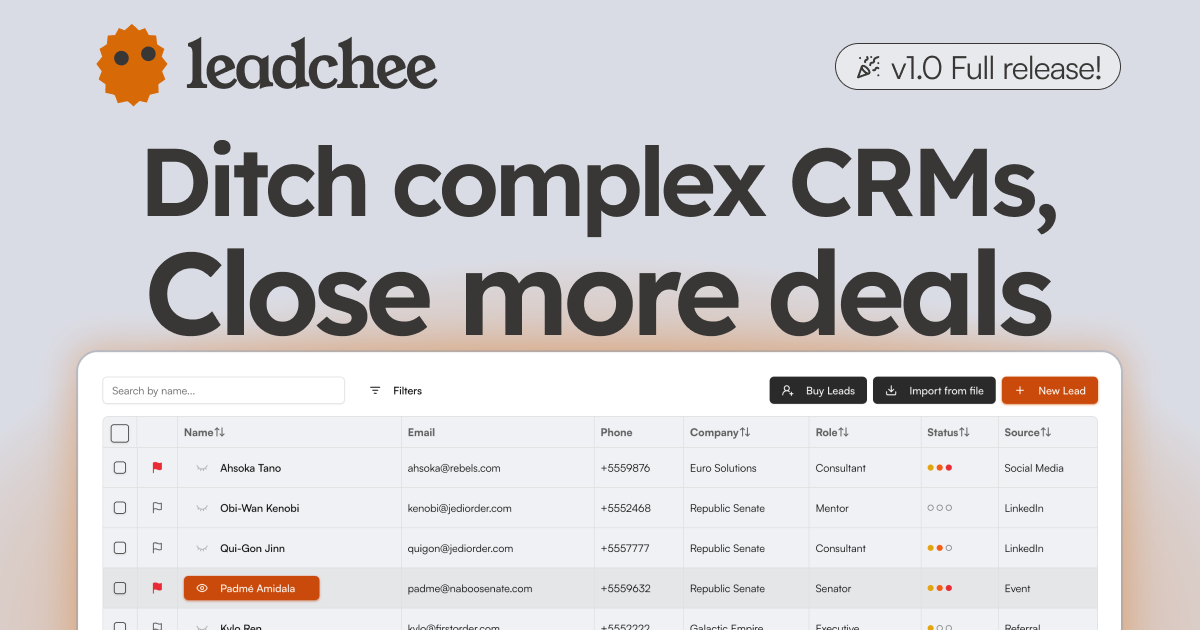
- AI-Powered Lead Scoring: Leadchee's scoring engine uses historical conversion data to rank leads, so you focus on the prospects most likely to buy. This isn't just a static score — it learns over time, improving its accuracy as your team closes more deals. For small teams, this replaces guesswork and manual weeding, meaning you can prioritize follow-ups 10x more efficiently.
- Generous Free Tier and Affordable Pricing: The freemium model lets you test the core features without a credit card, and paid plans start at $15/month. This pricing puts it within reach of startups and SMBs compared to Salesforce ($300+/user/month) or HubSpot (starting $45/month for paid tiers). Even the paid plans likely cost less than $100/month for a small team, making it a low-commitment experiment.
- Workflow Automation and Custom Templates: You can create automation rules that trigger actions — like sending a welcome email or assigning a lead to a sales rep — based on lead behavior or score changes. Custom templates for emails and outreach sequences save time on repetitive tasks, ensuring consistent follow-up. This is a practical feature for teams that lack a dedicated sales operations person.
- API Integration for Flexibility: The API allows you to connect Leadchee to your existing tech stack, whether it's a custom CRM, marketing tools, or internal dashboards. This is a significant advantage for companies that already have a martech ecosystem and need a simple lead management layer rather than a monolithic suite. With decent dev skills, you can sync data both ways.
- Contact Management and Lead Capture: The platform handles basic CRM duties — storing contacts, tracking interactions, and organizing leads into pipelines. The included web form capture makes it easy to collect leads from your site, and the automatic enrichment adds firmographic details, reducing manual entry. This integrated approach covers the essentials without requiring additional tools.
⚠ Watch out for
- No Mobile App: Leadchee does not offer a native mobile app, which severely limits on-the-go sales reps. If your team frequently updates deals or checks leads from their phones, you'll have to rely on the responsive web interface, which may not be optimized for all tasks. In 2026, a CRM without mobile access feels like a gap for field teams that need real-time updates.
- No Browser Extension: There's no browser extension for quick lead capture from websites or LinkedIn. Competitors like HubSpot and Salesforce offer such tools, which are time-savers for prospecting. Without it, you'll need to manually input or import leads, slowing down your workflow and erasing some of the automation benefit.
- Limited Integration Documentation: While Leadchee has an API, the website offers scant details on supported integrations beyond that. There's no public list of built-in connectors (e.g., Gmail, Slack, Zapier), so you may not know if it natively syncs with your existing marketing tools. This lack of transparency could lead to unexpected custom development costs.
- Unproven at Enterprise Scale: Leadchee is clearly built for SMBs. It lacks advanced features like territory management, complex forecasting, and multi-currency support that enterprises often need. While it works for small teams, scaling it to dozens of users or complex sales cycles could become a bottleneck due to its limited feature set and potential performance issues (though performance specifics are not publicly documented).
- Customer Support Availability: There's no live chat or phone support mentioned; the knowledge base and email support are the primary channels. For a platform that automates sales processes, getting prompt help when you're mid-campaign is critical. The lack of real-time support could be a deal-breaker for teams that need quick resolutions.
🎯 Best for
Small to medium-sized businesses looking for an affordable, AI-driven CRM to automate lead scoring, email marketing, and sales workflows.
🚫 Who should skip
Enterprises requiring strict data compliance (GDPR/SOC2), mobile access, or extensive pre-built integrations may find Leadchee lacking.
📚 Learning curve
Moderate - Setting up workflow automation and email marketing integrations takes some initial time, but the core interface is user-friendly.
🧑⚖️ Verdict
If you run a small B2B team that needs affordable, AI-driven lead capture and scoring without the overhead of a full CRM, Leadchee is a solid, cost-effective pick. If your team lives on mobile or requires deep native integrations with your entire stack, look elsewhere (e.g., HubSpot or Pipedrive). B
📊 Use Case Suitability
Higher score = better fit. Scores from editorial review.
🧭 Which One Should You Pick?
Choose Hubspot Breeze if...
- You are: Businesses already invested in HubSpot CRM who want to augment their sales, marketing, and service teams with built-in A
- 👍 Deep integration with HubSpot CRM means AI features enhance existing workflows without switching too
- 👍 Offers a unified AI platform with Copilot (chat/assistant), Agents (autonomous tasks), and Intellige
- 👍 Free tier available for basic AI use, making it accessible for small teams to test before upgrading.
- 💰 From $20/mo
- ⚠ Trade-off: Tied exclusively to HubSpot; not useful for teams using other CRMs or looking fo
Choose Leadchee if...
- You are: Small to medium-sized businesses looking for an affordable, AI-driven CRM to automate lead scoring, email marketing, and
- 👍 Affordable pricing tiers, including a free version, making it accessible for small businesses.
- 👍 AI-powered lead scoring automates prioritization and reduces manual effort.
- 👍 Workflow automation and custom templates streamline repetitive sales tasks.
- 💰 From $15/mo
- ⚠ Trade-off: No mobile app, limiting usability for sales teams that work on the go.
❓ Frequently Asked Questions
Is HubSpot Breeze free to use?
Breeze has a free tier with limited features, but full AI capabilities require a paid HubSpot subscription (Starter at $20/user/month, Professional at $100/user/month, or Enterprise at $500/user/month).
Does Breeze work outside of HubSpot CRM?
No, Breeze is deeply embedded within the HubSpot ecosystem and does not function as a standalone tool. It is designed to enhance HubSpot's CRM, marketing, sales, and service hubs.
What integrations does Breeze support?
Breeze leverages HubSpot's extensive native integrations with over 1,000 apps (including Salesforce, Mailchimp, Shopify, and Zapier) and offers an API for custom connections.
Can I use Breeze for content creation like blog posts or emails?
Yes, Breeze Copilot can draft blog posts, social media content, emails, and more within HubSpot, helping marketing and sales teams speed up content workflows.
🔗 More AI Sales Comparisons
🔀 Explore Alternatives
📧 Save this comparison
We'll email you a link to this comparison. No spam.