Simplifi by Quicken vs YNAB
Side-by-side comparison — pricing, features, ratings, use cases. Find which Budgeting Apps fits you best.
💰 Pricing
- Annual plan: $47.88/year (effectively $3.99/month), billed upfront.
- Monthly plan: $5.99/month.
- No additional fees for bank synchronization or transaction import.
- 30-day free trial with no credit card required.
- Automatic renewal at full annual rate after trial period ends.
- Price may increase with prior notice; no price lock for existing subscribers.
🔧 Features
📋 Assessment
💪 Strengths
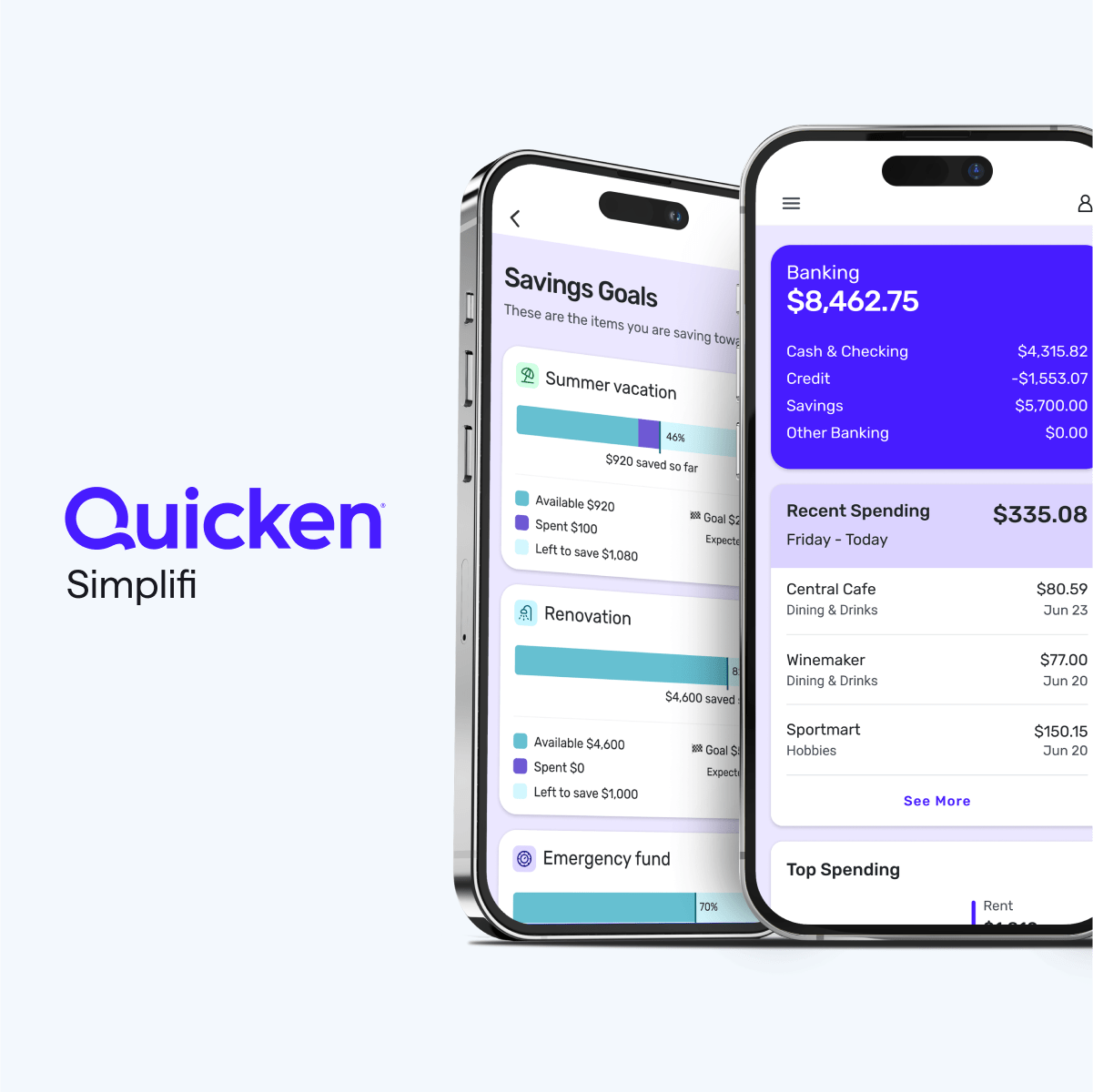
- The interface is wonderfully clean and uncluttered. Unlike classic Quicken, which can feel like a spreadsheet, Simplifi uses cards and simple lists to show you your financial picture. For example, the 'Spending Plan' shows your income minus planned bills and spending, and updates in real time as transactions come in. This makes it perfect for people who find traditional budgeting overwhelming.
- The cash flow forecast is a killer feature. It takes your upcoming bills, income, and spending habits to project your account balance day-by-day. You can see if you'll be at risk of overdrawing in two weeks or if you'll have extra cash for a splurge. This proactive insight is something few competitors offer at this price point.
- The 'Watchlist' feature lets you tag specific merchants or spending categories (like 'Starbucks' or 'Dining Out') and see how much you're spending on them each month. It's a great way to keep an eye on problematic spending without having to build a complex budget.
- Subscription monitoring is built in. Simplifi identifies recurring subscriptions (like Netflix, gym memberships, etc.) and lists them in one place. It even flags price increases or duplicate charges, which is a practical way to trim monthly expenses.
- Bank sync is generally reliable, with support for thousands of financial institutions. It also allows manual account additions, so you can track cash or accounts that don't link. The 'Pending' transaction handling is smooth, and it lets you easily split transactions (like a grocery store shopping trip that includes household items and personal items).
⚠ Watch out for
- Investment tracking is basic. You see holdings and market values, but there's no capital gains calculator, no tax-loss harvesting tool, and no in-depth performance analysis. For example, you can't see your asset allocation across accounts or drill into a specific lot's cost basis. If you're an active investor, you'll need another tool.
- No true multi-user support. The only way for couples to share is to log in with the same credentials. This is not user-friendly and can lead to sync issues if both partners are entering transactions simultaneously. You also can't set up separate roles with different permissions.
- International support is weak. The app focuses on US financial institutions and USD. If you have a foreign bank account or deal with multiple currencies, you'll be disappointed. The sync may fail, and you'll have to manually update transactions.
- The Spending Plan can be too flexible for some. Unlike envelope budgeting, it doesn't enforce hard limits. If you constantly overspend in a category, it just adjusts your plan without much friction. This is great for some, but for people who need discipline, it might not be restrictive enough.
- Customer support is average. You get email and chat support, but there's no phone line. Response times can be slow during peak seasons, and the knowledge base is thin on troubleshooting. Some users have reported that support staff lack deep technical knowledge.
🎯 Best for
Individuals or couples who want a low-effort, flexible way to track spending, monitor cash flow, and see simple investment balances without overcomplicating budgeting.
🚫 Who should skip
Investors who need portfolio-level analytics or people who prefer a hard zero-sum budgeting method like YNAB might find Simplifi too shallow.
📚 Learning curve
Minimal — most users can link accounts and set up a Spending Plan in under 30 minutes.
🧑⚖️ Verdict
Simplifi is a strong choice for budgeting beginners and those who want a simple, intuitive way to track spending and project cash flow. It's not ideal for advanced investors or couples needing true multi-user access. Bottom line: If you want a modern, flexible budgeting app with great cash flow fore
.png)
💰 Pricing
- Monthly subscription: $14.99 USD/month billed monthly
- Annual subscription: $99 USD/year billed upfront (equivalent to $8.25/month)
- 34-day free trial available for all new users
- Students receive 12 months free with college/university verification
- Bank sync included at no extra cost
- No credit card is required for the free trial, but if you choose the annual plan, the full $99 is charged upfront
- Annual plan auto-renews at the same rate unless canceled before renewal date
- Student plan requires share of verified student status; if verification expires before 12 months, you may be billed the standard rate
- If you cancel during the trial, access ends immediately — no partial refunds for annual plans
🔧 Features
📋 Assessment
💪 Strengths
- YNAB's zero-based budgeting method forces you to give every dollar a job, which eliminates the 'leftover money' problem that plagues traditional budgets. By assigning each dollar to a category—whether it's rent, groceries, or a vacation fund—you make intentional spending decisions. This method is highly effective in reducing mindless spending and increasing savings rates, as evidenced by user testimonials and industry reviews.
- The goal-tracking system is remarkably robust. You can set targets for monthly bills, true expenses (like car registration or holiday gifts), and debt payoff. Each category can have a funding target, such as a specific amount by a date, or a monthly savings goal. YNAB then tells you exactly how much to allocate each month to hit those goals, ensuring you're prepared for irregular expenses that often destroy budgets.
- Cross-platform availability is seamless. YNAB offers a web app and mobile apps for iOS and Android that sync in real time. This means you can check your budget on your phone while at the store, or update your budget on your laptop at home. The mobile app includes features like quick transaction entry and location-based suggestions, making it easy to keep your budget current on the go.
- The 'Age Your Money' feature is a powerful motivator. It calculates how many days your cash has been sitting in your bank account after covering expenses. The goal is to increase this number to at least 30 days, which builds a buffer and reduces reliance on your next paycheck. This gamification of financial health is unique to YNAB and helps foster a longer-term perspective on spending.
- YNAB's reporting tools, though not as detailed as some competitors, provide insightful overviews of spending trends, net worth, and income vs. expenses. These reports help you identify areas where you're overspending and track your progress over time. The 'Income vs. Expense' report, in particular, is useful for seeing how your budget aligns with your actual spending.
⚠ Watch out for
- The subscription cost is a significant barrier for many. At $14.99 per month (or $99/year), YNAB is considerably more expensive than free alternatives like Monarch Money's basic plan or even a simple spreadsheet. While the methodology and features justify the price for some, budget-conscious users may find it hard to pay for a budgeting app when they're trying to save money. There's no free lifetime tier, only a trial, which can be a dealbreaker.
- The learning curve is steep. For those unfamiliar with zero-based budgeting, YNAB's terminology (e.g., 'To Be Budgeted', 'True Expenses', 'Age Your Money') can be confusing initially. The setup process requires categorizing all expenses and assigning jobs to existing funds, which can take several hours. Without prior budgeting experience, users may feel overwhelmed and abandon the app. Even with YNAB's extensive educational resources, the initial mental shift is a significant hurdle.
- Bank synchronization occasionally fails. While YNAB uses secure bank connections, users have reported issues where transactions don't import for days, or sync errors occur. Relying solely on automatic import can lead to missed transactions, which defeats the purpose of a real-time budget. You often need to manually reconcile accounts, which adds to the maintenance load. This is a common issue among budgeting apps, but it's worth noting.
- The reporting features are fairly basic compared to competitors like Monarch Money or Mint. You can't create custom charts or detailed analytics; you're limited to preset reports on spending, income, and net worth. For users who want granular insights into their financial trends, this may be limiting. However, YNAB's focus is on budgeting, not advanced analytics.
- No support for multi-currency or investment accounts is a notable limitation. YNAB primarily handles cash and budget accounts; you can't track investment portfolios or crypto assets in detail. You can add investment accounts as tracking accounts, but they won't integrate with the budgeting categories. This might be a drawback for users with diverse financial portfolios.
🎯 Best for
YNAB is ideal for individuals or couples who are committed to hands-on, proactive budgeting and want a proven method to stop living paycheck-to-paycheck, build savings, and get out of debt.
🚫 Who should skip
If you prefer a passive, automated budgeting tool that just tracks spending without requiring manual assignment of every dollar, or if you are unwilling to pay a subscription fee, you should skip YNAB.
📚 Learning curve
Steep — YNAB requires understanding and adopting the zero-based budgeting philosophy, which takes time for new users to fully grasp and implement correctly.
🧑⚖️ Verdict
YNAB is a powerful budgeting tool for those ready to commit to zero-based budgeting and meticulous financial planning. It's worth the subscription for anyone struggling with irregular expenses or debt, but free alternatives may suffice for casual budgeters. Bottom line: YNAB transforms your financia
📊 Use Case Suitability
Higher score = better fit. Scores from editorial review.
🧭 Which One Should You Pick?
Choose Simplifi by Quicken if...
- You are: Individuals or couples who want a low-effort, flexible way to track spending, monitor cash flow, and see simple investme
- 👍 Simple and intuitive user interface that is far less cluttered than classic Quicken, making it easy
- 👍 Spending Plan is flexible and forgiving—it doesn't lock you into strict envelope budgets; it adjusts
- 👍 Cash flow projection is a standout feature, showing your expected account balance at any future date
- 💰 From $3.99/mo
- ⚠ Trade-off: Limited investment tools—no in-depth tax planning, cost basis analysis, or advan
Choose YNAB if...
- You are: YNAB is ideal for individuals or couples who are committed to hands-on, proactive budgeting and want a proven method to
- 👍 Forces an intentional zero-based budget, giving every dollar a specific job and reducing mindless sp
- 👍 Strong goal-tracking system that supports saving for true expenses, debt payoff targets, and one-off
- 👍 Cross-platform availability with web and mobile apps that sync in real time, making it easy to check
- 💰 From $14.99/mo
- ⚠ Trade-off: Subscription cost is high compared to free or cheaper budgeting apps like Monarc
❓ Frequently Asked Questions
Is Simplifi a strict budget or a spending tracker?
It's a spending plan rather than a strict budget. You set planned amounts for categories, but the app emphasizes flexibility and taking action when you're over or under instead of hard limits.
Can I track investments with Simplifi?
Yes, you can link investment accounts and see balances, performance, and holdings. But it's basic—there's no advanced tax-loss harvesting, cost basis analysis, or deep retirement planning.
Does Simplifi connect to my bank accounts?
It supports thousands of US financial institutions via direct account aggregation. You can link checking, savings, credit cards, loans, and investment accounts automatically.
How much does Simplifi cost and is there a free trial?
Simplifi is $3.99 per month, typically billed annually at about $47.88 per year. There is usually a 30-day free trial so you can test it before paying.
🔗 More Budgeting Apps Comparisons
🔀 Explore Alternatives
📧 Save this comparison
We'll email you a link to this comparison. No spam.