SurveyMonkey vs WhatConverts
Side-by-side comparison — pricing, features, ratings, use cases. Find which Marketing fits you best.
💰 Pricing
📋 Assessment
💪 Strengths
- SurveyMonkey's survey builder is exceptionally user-friendly. The drag-and-drop interface allows you to add and rearrange questions effortlessly, and there is a library of over 200 pre-written questions and expert templates. This means you don't need to be a survey design expert to create effective surveys. The platform provides real-time suggestions to improve question clarity, helping you avoid biased or confusing wording, which is a huge time-saver.
- Advanced logic features (skip logic and branching) allow you to personalize the survey based on previous answers, making the experience more relevant for respondents. This reduces abandonment rates and improves data quality. You can also randomize answer choices and use piping to insert previous responses into later questions, which is a sophisticated feature not always found in lower-priced tools.
- Robust data analysis and visualization tools make it easy to interpret results. You get real-time charts and graphs, and you can filter results by segment (e.g., age, location, or custom variables). The cross-tabulation feature lets you compare responses across different groups, revealing meaningful insights. The AI-powered insights tool automatically highlights trends and anomalies in your data, saving you time on manual analysis.
- SurveyMonkey offers a wide range of integrations that extend its functionality. Native integrations with Salesforce, HubSpot, Slack, and Mailchimp allow you to sync survey responses with your CRM or communication tools, automating follow-up actions. For example, you can trigger a support ticket when a customer rates their experience poorly, ensuring timely response. This connectivity is crucial for businesses that want to integrate feedback into their workflows.
- The platform is compliant with major data protection regulations, including GDPR and CCPA, and offers SOC 2 Type II certification. This is essential for enterprises handling sensitive data. Additionally, surveys are SSL encrypted by default, and you can set up password protection for extra security. For global deployment, SurveyMonkey has language support, allowing you to translate surveys into multiple languages.
⚠ Watch out for
- The free plan is quite limited, allowing only 10 questions per survey and 100 responses per month (though they've recently changed this to 10 responses per survey, which is even more restrictive). You also don't get access to advanced features like skip logic or data export to Excel. This means that for any serious surveying, you'll need to upgrade to a paid plan, which might be a barrier for small businesses or casual users.
- The pricing model is consumption-based, which can get expensive as your response volume grows. Plans are tiered by number of responses per month (e.g., 100, 500, 1000), and once you exceed that, you pay overage fees or need to upgrade. For surveys that receive a high response rate, the cost can quickly increase, making it less predictable than flat-rate competitors like Typeform or Google Forms.
- Some users report that the user interface feels a bit clunky and outdated compared to more modern survey tools. The drag-and-drop builder works, but the design aesthetics are functional at best. Customization options for branding are limited — while you can add your logo and change colors, you can't completely customize the survey's look and feel without using CSS tricks, which is not ideal for customer-facing surveys that need to match your brand's visual identity.
- Data export capabilities are limited on lower-tier plans. For example, the Standard plan only allows you to export your data to CSV and PDF, but if you want to export to Excel or SPSS, you need to upgrade to a higher plan. This can be frustrating for researchers who need to perform advanced statistical analysis in specialized software.
- Customer support is not the most responsive. While there is a comprehensive help center and 24/7 email support, there is no live chat or phone support for standard plans. Higher-tier plans (e.g., Premier) offer priority support via phone, but that comes at a premium price. For users who need quick help, particularly during time-sensitive surveys, the lack of real-time support can be a drawback.
🎯 Best for
Small to mid-sized teams and individual researchers who need an easy-to-use, reliable tool for short surveys and quick feedback with room to scale via paid plans.
🚫 Who should skip
Budget-conscious teams or those needing unlimited responses and advanced logic without high costs should consider Google Forms or Jotform instead.
📚 Learning curve
Minimal — the drag-and-drop interface, pre-made templates, and clear dashboard make it usable within minutes for most beginners.
🧑⚖️ Verdict
For those needing a reliable, feature-rich survey tool with strong analytics and integrations, SurveyMonkey is a solid choice—especially for businesses that handle moderate to high response volumes. It's not the most budget-friendly option for small-volume users, who may prefer Google Forms or Typef
💰 Pricing
📋 Assessment
💪 Strengths
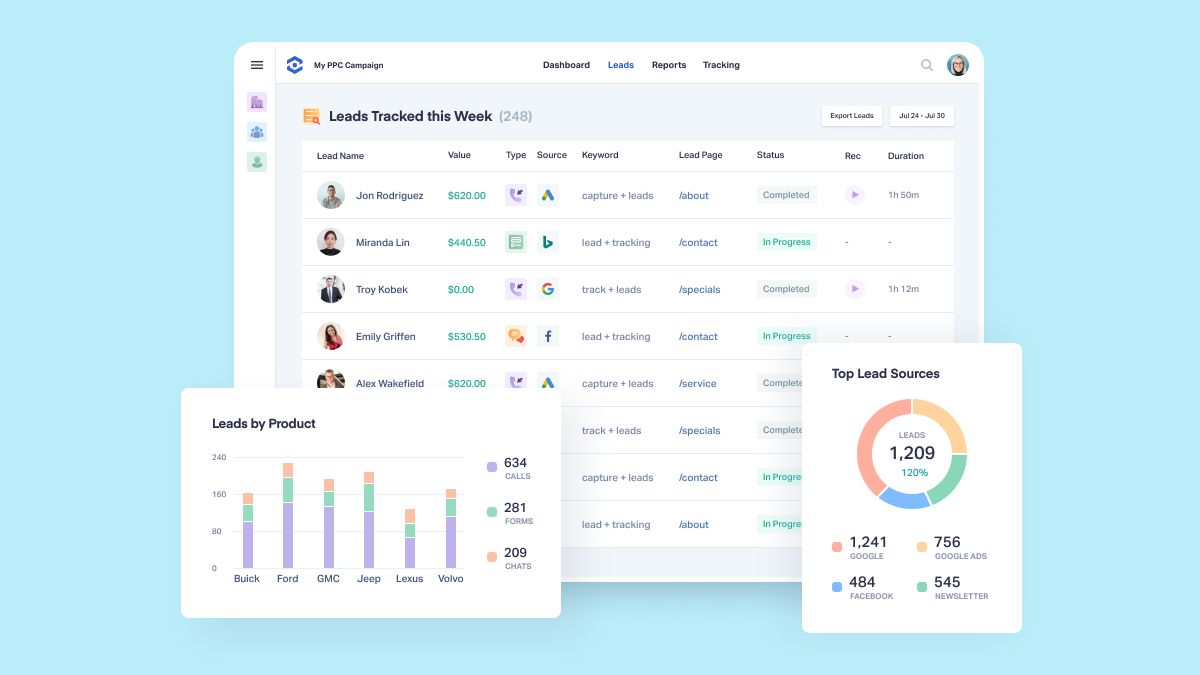
- WhatConverts shines with its unified tracking of calls, forms, chats, and clicks, all in one dashboard. This eliminates the need for multiple tools and provides a complete picture of a lead's journey, making attribution more accurate and reducing data silos. For agencies, this means no more guessing which channel actually drove the conversion.
- The platform offers excellent agency-focused features like client reports and a partner dashboard. You can efficiently manage multiple clients from one account, create custom reports that spell out marketing ROI, and control access with role-based permissions. This streamlines workflows and keeps clients informed.
- Its lead generation and management tools, including a built-in CRM and lead distribution, are surprisingly robust. Leads can be automatically routed to the right salesperson or integrated with popular CRMs like Salesforce and HubSpot. This helps turn raw leads into tangible sales opportunities, directly impacting revenue.
- The call tracking capabilities are top-notch, with dynamic number insertion, call recording, and detailed call insights. You can see exactly which keyword or ad triggered a call, hear the conversation to gauge quality, and even track outcomes like successful sales or appointments. This level of detail is invaluable for optimizing campaigns.
- The integration ecosystem is quite strong, with native integrations for major platforms like Google Ads, Facebook, and leading CRMs, as well as support for Zapier. This makes it easy to incorporate WhatConverts into existing marketing stacks without extensive custom development.
⚠ Watch out for
- The free plan is quite limited, only offering basic lead tracking for a single user. To access essential features like call tracking, form tracking with custom fields, and integrations, you must upgrade to a paid plan starting at $30/month. This may be steep for freelancers or very small businesses just starting out.
- The user interface, while functional, feels somewhat dated and can present a learning curve for first-time users. Navigating through the many settings and reports can be overwhelming, especially for those unfamiliar with lead tracking terminology. The platform could benefit from a more intuitive, modern design.
- The reporting, while comprehensive, can sometimes be overwhelming with too many metrics and options. Customizing reports to show only the most relevant data requires a bit of effort. Some users might prefer a more streamlined, pre-built reporting experience.
- WhatConverts primarily focuses on tracking leads that occur via digital interactions. It does not integrate directly with offline marketing channels like direct mail or billboards unless you manually add them. This could be a limitation for agencies managing multi-channel campaigns that include offline elements.
- While the platform offers robust integrations, the setup process can be complex, particularly for non-technical users. Implementing tracking code across multiple websites and configuring the various integration settings may require a developer or at least some technical proficiency.
🎯 Best for
Marketers, media buyers, and agencies that need undeprecated call and lead tracking to prove attribution across paid, organic, and offline campaigns.
🚫 Who should skip
Small businesses or solo marketers who only need basic analytics and don't require multi-channel attribution or agency-style reporting.
📚 Learning curve
Moderate — setting up dynamic numbers and tracking tags isn't complex, but configuring reporting and integrations takes time.
🧑⚖️ Verdict
WhatConverts is an excellent choice for marketing agencies that need comprehensive lead tracking and client reporting in one place. Its unified tracking and strong integrations make it a powerful tool for demonstrating ROI. However, smaller businesses on a tight budget may want to start with the fre
📊 Use Case Suitability
Higher score = better fit. Scores from editorial review.
🧭 Which One Should You Pick?
Choose SurveyMonkey if...
- You are: Small to mid-sized teams and individual researchers who need an easy-to-use, reliable tool for short surveys and quick f
- 👍 Drag-and-drop survey builder is extremely intuitive and requires no coding experience.
- 👍 Large library of professionally designed templates for common use cases like customer feedback, even
- 👍 Robust paid integrations with Salesforce, Slack, Mailchimp, and Zapier streamline workflow automatio
- 💰 Free tier available
- ⚠ Trade-off: Free plan only allows 10 questions per survey and 100 responses per survey, whic
Choose WhatConverts if...
- You are: Marketers, media buyers, and agencies that need undeprecated call and lead tracking to prove attribution across paid, or
- 👍 Combines phone, chat, form, and click tracking in one platform, eliminating the need for multiple di
- 👍 Built specifically for agencies, with client-level dashboards, lead routing, and white-label reporti
- 👍 Dynamic number insertion provides granular attribution down to the keyword, ad, or even exact visito
- 💰 From $50/mo
- ⚠ Trade-off: The free tier is quite restricted; multi-user access, advanced reporting, and ma
❓ Frequently Asked Questions
Is SurveyMonkey really free?
Yes, there is a free plan, but it limits each survey to 10 questions and 100 responses per survey. You also get core features like templates and basic reporting, but advanced features require a paid subscription.
Can I create unlimited surveys on the free plan?
Yes, you can create unlimited surveys on the free plan. However, each survey has the 10-question and 100-response caps per survey period.
🔗 More Marketing Comparisons
🔀 Explore Alternatives
📧 Save this comparison
We'll email you a link to this comparison. No spam.