Connecteam vs Planday
Side-by-side comparison — pricing, features, ratings, use cases. Find which Workforce Management fits you best.
💰 Pricing
🔧 Features
📋 Assessment
💪 Strengths
- The shift scheduling module is a standout. It supports templates for repeating shifts, employee availability and time-off requests, shift swapping with manager approval, and automatic reminders via push notification or SMS. This reduces no-shows and the back-and-forth of manual scheduling. For managers coordinating multiple departments or locations, the ability to duplicate schedules and assign roles is a genuine timesaver.
- The free plan covers up to 10 users with all essential features, which is more generous than most competitors (Sling's free plan caps at 2 users, Homebase's at 1 location). For a small business that's just starting to digitize workforce management, this is an easy way to test the platform without financial commitment. No credit card is required, and the plan is not time-limited.
- Communication tools are integrated into the app, offering a company-wide feed, private and group chats, and one-on-one direct messaging. This eliminates the need for a separate tool like WhatsApp or Slack and keeps work conversations in a professional context. You can also segment audiences (e.g., by role or location), which is useful for targeted announcements like safety warnings or schedule changes.
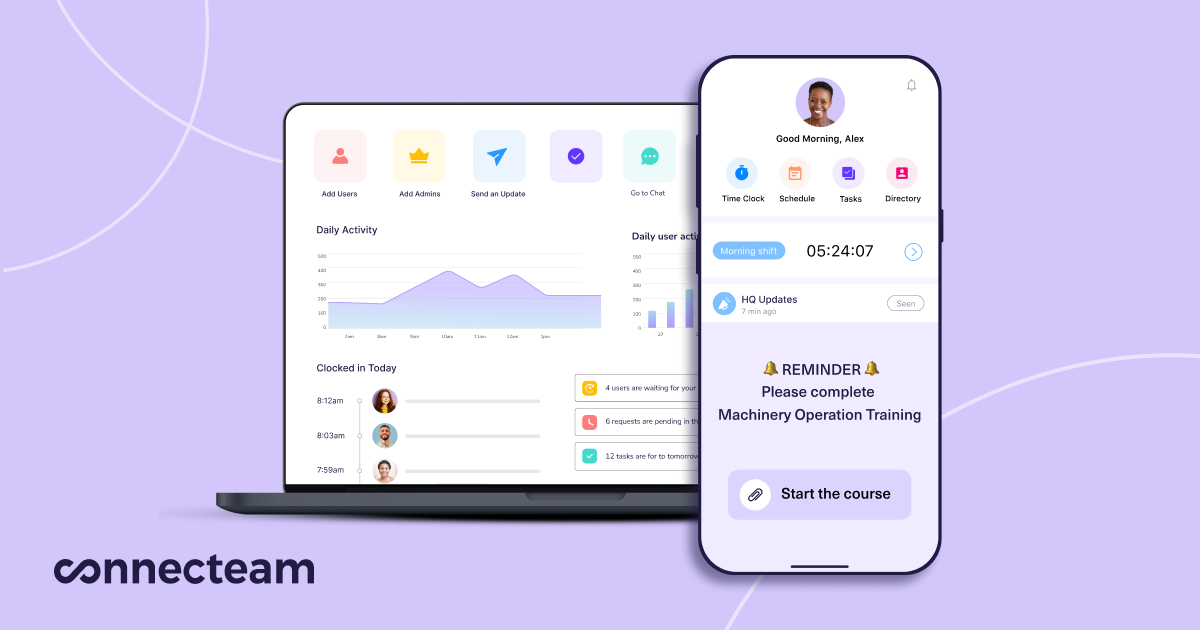
- The training and onboarding module allows you to upload videos, documents, and web links, create quizzes, and assign courses to individuals or whole teams. Managers can track completion and scores, which is invaluable for compliance training or standardizing onboarding across locations. This feature typically costs extra in other platforms, so its inclusion at most tiers is a strong value proposition.
- Task management with checklists and GPS verification is built-in. You can assign recurring or one-off tasks, attach photos, and set deadlines. Field teams especially benefit from GPS tagging and proof of completion, as it provides a digital paper trail for audits and accountability.
⚠ Watch out for
- Advanced HR features are missing. Connecteam does not offer payroll processing, benefits administration, or built-in compliance management (like ACA tracking or labor law posters). You'll need to integrate with third-party apps like QuickBooks or Gusto via Zapier or API (higher tiers only), which adds complexity and cost. Businesses needing those features should look at dedicated HR platforms.
- Some critical features are tier-gated. For example, advanced reporting and custom dashboards, API access, and priority support are only available on the Professional or Enterprise plans. The Basic plan ($29/month) lacks these, which could frustrate growing businesses that need data export or system integrations.
- The user interface is cluttered. With so many modules and customization options, the left sidebar is long, and home screen widgets can overwhelm. New users may feel lost initially, especially less tech-savvy employees. It's not intuitive enough for a 'plug-and-play' experience.
- Performance can lag on older smartphones. The app is feature-rich, but on devices with limited RAM or older Android/iOS versions, users report slower loading times and occasional crashes. This is a consideration for teams that rely on older hardware.
- Customer support has mixed reviews. While they offer 24/7 chat and email, response times can be slow for free plan users, and some users report that support reps lack deep technical knowledge for complex issues. Phone support is only available on higher tiers.
🎯 Best for
Small to mid-sized businesses with hourly or non-desk employees who need a simple, affordable way to manage scheduling, communication, and training in one mobile app.
🚫 Who should skip
Companies with complex HR, payroll, or benefits needs that require a full HRIS or ERP, and businesses already using mature tools like Deputy or Sling may find overlap without added value.
📚 Learning curve
Moderate — the app is user-friendly for frontline staff, but administrators need time to configure all modules, permissions, and automations before launch.
🧑⚖️ Verdict
Connecteam is a powerful, all-in-one workforce management solution for small to mid-sized businesses with non-desk employees, offering incredible value with its flat-rate pricing and generous free plan. However, if you need robust HR features like payroll, benefits, or advanced compliance, or requir
💰 Pricing
🔧 Features
📋 Assessment
💪 Strengths
- The drag-and-drop shift planner is intuitive and efficient, allowing managers to create complex rosters in minutes. Recurring shift templates and copy functionality mean that weekly schedules can be generated with a few clicks, saving significant time for managers who would otherwise build schedules from scratch. This feature is especially valuable in industries like hospitality, where shift patterns are repetitive and constant.
- The employee mobile app is a major selling point. Staff can view their shifts, request time off, and swap shifts with colleagues without needing managerial approval, as long as they meet predefined rules. This self-service capability reduces the number of administrative requests managers handle and empowers employees to manage their own work-life balance, leading to higher satisfaction and fewer scheduling conflicts.
- Planday integrates seamlessly with leading payroll providers such as ADP, QuickBooks, and Personio. This two-way integration ensures that hours worked are accurately captured and automatically transferred to payroll, eliminating manual data entry errors and saving HR teams hours of work each pay period. For businesses already using these payroll systems, this integration is a major time-saver.
- The platform offers robust reporting tools, including labor cost forecasting and budget tracking. Managers can monitor labor costs in real-time against revenue, helping them make data-driven decisions about staffing levels. This feature is particularly useful for businesses that need to closely manage overtime and stay within budget.
- Availability-based scheduling is a core strength. Employees can input their availability and time-off requests in advance, and the system automatically flags conflicts when building schedules. This reduces the risk of understaffing or overstaffing, and it makes the scheduling process more predictable for both managers and staff.
⚠ Watch out for
- Planday does not offer a permanent free plan. The free trial ends after a set period, and then you must pay a recurring per-employee fee. For large teams, these costs can add up quickly, making Planday more expensive than some competitors that offer flat-rate pricing or a freemium tier. This is a significant consideration for budget-conscious small businesses.
- While Planday integrates with payroll providers, it does not offer native payroll processing. You still need a separate payroll service to actually pay your employees. This means two subscriptions and a dependency on third-party systems. For businesses looking for an all-in-one solution, this could be a drawback.
- Advanced features, such as multi-location reporting, custom permissions, and advanced analytics, are only available on higher-priced subscription tiers. Small businesses on the basic plan may find these limitations restricting, especially if they operate across multiple sites. The tiered pricing model can force an upgrade sooner than expected.
- The onboarding process can be time-consuming for larger organizations, especially when setting up integrations with payroll providers. While the interface is user-friendly, initial data migration and configuration of rules and permissions require careful planning. Some users report that the support team's response times can be slow during peak hours.
- The mobile app, while functional, has been reported to have occasional performance issues, such as lag or syncing delays. This can be frustrating for employees who rely on the app to check their schedules or request swaps. These issues, while not universal, are a point of concern for a product that depends heavily on mobile usability.
🎯 Best for
Planday is best for shift-based employers in hospitality, retail, and care sectors with hourly staff who need efficient scheduling, shift management, and payroll integrations.
🚫 Who should skip
Freelancers, very small teams, or anyone looking for a completely free or lightweight scheduling tool should skip Planday, as should companies that require project management or performance tracking features.
📚 Learning curve
Moderate — building schedules is intuitive, but configuring payroll integrations, compliance rules, and multi-location workflows requires more time and training.
🧑⚖️ Verdict
Planday is an excellent choice for businesses with shift-based hourly employees that prioritize scheduling efficiency and employee self-service. Its integrations with payroll systems are a major plus, especially for those already using ADP or QuickBooks. However, the lack of a free plan and escalati
📊 Use Case Suitability
Higher score = better fit. Scores from editorial review.
🧭 Which One Should You Pick?
Choose Connecteam if...
- You are: Small to mid-sized businesses with hourly or non-desk employees who need a simple, affordable way to manage scheduling,
- 👍 All-in-one mobile app that combines scheduling, communication, training, and task management for des
- 👍 Generous free plan for up to 10 users, making it accessible to very small businesses.
- 👍 Strong shift scheduling features including templates, availability, shift swapping, and reminders.
- 💰 From $29/mo
- ⚠ Trade-off: Advanced HR features like payroll processing, benefits administration, and full
Choose Planday if...
- You are: Planday is best for shift-based employers in hospitality, retail, and care sectors with hourly staff who need efficient
- 👍 Drag-and-drop shift planning with recurring shift templates and copy functionality, which saves time
- 👍 Employee mobile app lets staff view shifts, request time off, and swap shifts without needing direct
- 👍 Two-way integrations with payroll providers such as ADP, QuickBooks, and Personio reduce manual data
- ⚠ Trade-off: No permanent free plan; the free trial ends and recurring per-employee fees appl
❓ Frequently Asked Questions
How much does Connecteam cost?
Connecteam has a free plan for up to 10 users and paid tiered plans based on employee count. For many small businesses, paid plans start around $29 per month, which aligns with the $200-$300 per business signup mentioned in the listing.
Is there a free trial or free version?
Connecteam offers a free plan for up to 10 users and a 14-day free trial for paid plans. The free version includes many core scheduling, communication, and training features, which makes it easy to test.
🔗 More Workforce Management Comparisons
🔀 Explore Alternatives
📧 Save this comparison
We'll email you a link to this comparison. No spam.