InvokeAI vs Wand
Side-by-side comparison — pricing, features, ratings, use cases. Find which Ai Image Generation fits you best.
💰 Pricing
🔧 Features
📋 Assessment
💪 Strengths
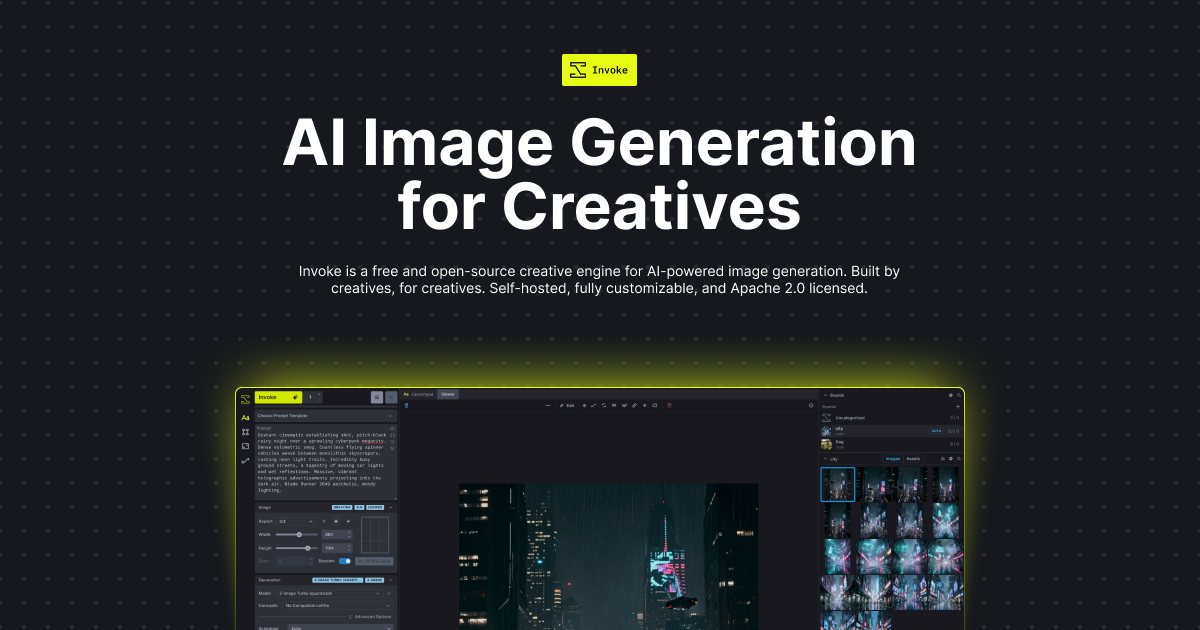
- The unified canvas is a game-changing feature that sets InvokeAI apart. Instead of juggling separate tabs for generation, inpainting, and upscaling, you can manipulate a virtual canvas — layering images, drawing masks, and iterating on sections seamlessly. This makes complex edits, like fixing a hand or changing a background, intuitive and efficient. It's a level of control that cloud tools lack.
- Full offline operation is a massive privacy and security win. Since everything runs on your local GPU, there's no risk of your prompts or generated images being stored on a server. This is crucial for professionals working on confidential projects, like a design firm prototyping for a client under NDA. No data ever leaves your machine.
- The depth of customization is unmatched. You can integrate ControlNet for pose/structure control, train and apply LoRA models for consistent styles, and use the model manager to install a wide array of Stable Diffusion checkpoints. This means you're not locked into one style — you can craft a workflow that produces exactly the aesthetic you need.
- The inpainting and outpainting tools are particularly robust. You can select a specific region of an image, mask it, and regenerate only that area with a new prompt, or extend the canvas outward for a larger composition. The results are seamlessly blended, and the ability to do this non-destructively on a canvas layer is a pro-level feature.
- Being open-source, InvokeAI benefits from continuous community-driven development. New features, model support, and performance improvements are added regularly. Since it's free, there's no cost to staying current, and you can even contribute to the codebase if you're so inclined.
⚠ Watch out for
- Hardware requirements are steep. InvokeAI runs on a local GPU, and to get usable speeds you'll need an NVIDIA card with at least 8GB of VRAM. Integrated graphics are a non-starter. This automatically excludes a huge portion of hobbyists and students who don't have a dedicated gaming PC. The software simply won't deliver a good experience on a typical laptop.
- The installation and setup process is definitely a hurdle. While InvokeAI provides installers, you still need to manage Python environments, install CUDA, and troubleshoot missing dependencies. There's no cloud-based trial to 'try before you buy,' so you have to commit to the setup before you even see if it runs. This is a significant barrier for non-technical users.
- The interface, especially the node-based canvas, has a steep learning curve. Even with the simplified 'unified canvas,' you have to understand concepts like layers, masks, and node graphs. A complete beginner could spend hours just learning how to perform a basic edit. It's powerful, but far from intuitive compared to drag-and-drop tools.
- There is no web interface, mobile app, or API. So if you want to generate images on the go, you're out of luck. The lack of an API is a major drawback for developers who might want to integrate AI image generation into their apps, and the absence of any cloud option means you must be at your local machine to use it.
- Customer support is community-based. There's no formal support team, so you rely on Discord channels and GitHub issues. While the community is generally helpful, you can't expect a guaranteed response time. If you get stuck, you're on your own to search for solutions or wait for a community member to respond.
🎯 Best for
Artists, designers, and AI enthusiasts who want full control over Stable Diffusion generation locally, value privacy, and are comfortable with a moderately technical setup.
🚫 Who should skip
Users who prefer a simple, web-based image generator with no installation required, or those without a dedicated GPU capable of running Stable Diffusion models.
📚 Learning curve
Steep — while basic text-to-image is straightforward, mastering the node-based interface, advanced features like ControlNet, and model management takes significant time and experimentation.
🧑⚖️ Verdict
Buy InvokeAI if you're a serious artist, indie developer, or designer with a capable NVIDIA GPU who values privacy, customization, and no per-usage costs. Look elsewhere if you lack technical patience or a GPU — a cloud service will be far smoother. For those it fits, it's the best open-source image

💰 Pricing
🔧 Features
📋 Assessment
💪 Strengths
- Wand’s sketch-to-image conversion is outstanding. Unlike text-based generators that often require complex prompt tweaking, Wand lets you draw a rough sketch—a few lines, a basic shape—and it instantly renders a detailed, high-resolution image. The process is intuitive and fast, making it accessible to anyone, regardless of technical skill. For artists, this is a tremendous time-saver, turning rough ideas into polished visuals in seconds.
- The Pro plan at $15/month includes unlimited credits, which is a standout feature in a market where many tools charge per image or offer limited monthly boosts. This means you can experiment freely, generate countless variations, and refine your sketches without worrying about hitting a credit cap. For freelancers and studios, this is a cost-effective solution that encourages creative exploration without financial penalty.
- Wand includes powerful upscaling and style transfer features. Upscaling allows you to take a low-res sketch and turn it into a crisp, high-resolution final image, suitable for print or digital use. Style transfer lets you apply different artistic styles—such as watercolor, oil painting, or anime—to your sketch, giving you creative control over the final aesthetic. These features are integrated seamlessly into the web interface, making them easy to use.
- The web interface is incredibly simple and user-friendly. There’s no software to install, no complex settings, and no learning curve. You just sign up, upload a sketch, and start generating. This is a major advantage for non-technical users like traditional artists or hobbyists who want AI assistance without dealing with technical jargon or steep learning curves. Wand respects your time by keeping the UI clean and focused.
⚠ Watch out for
- Wand lacks any text-to-image capability. If you want to generate an image from a text description—like 'a futuristic city skyline at sunset'—you can't do that here. This is a major limitation for users who prefer or need to work from textual prompts, which is a core feature in almost every other AI image generator on the market. It puts Wand in a specific niche, excluding a large segment of potential users.
- There is no API available. For developers or tech-savvy creators who want to integrate AI image generation into their own apps, websites, or automated workflows, this is a dealbreaker. Wand is a closed system, meaning you can’t programmatically send sketches or receive images. This limits its use in production pipelines, making it unsuitable for software companies or hobbyist coders.
- Wand does not offer a mobile app. In an age where phones and tablets are primary creative tools for many, the absence of a mobile companion app is a significant oversight. You’re forced to use a desktop browser, which can be inconvenient for artists who like to sketch away from their desks or need to capture quick ideas on the go. This hinders portability and flexibility.
- The interface, while simple, lacks advanced editing controls. You can’t fine-tune the generated result within Wand itself—such as adjusting lighting, composition, or specific elements—without re-uploading and re-specifying. This means you may need to export to other software like Photoshop for final adjustments, adding an extra step to your workflow. It’s a limitation for professionals who expect granular control.
🎯 Best for
Artists, designers, and hobbyists who want to quickly transform hand-drawn sketches into high-quality images without needing complex AI tools.
🚫 Who should skip
Users who need text-to-image generation, API integration, mobile access, or clear commercial usage rights should look elsewhere.
📚 Learning curve
Minimal — just upload a sketch and choose options; no technical knowledge needed.
🧑⚖️ Verdict
Wand is a specialized tool that excels at turning sketches into stunning images, making it a great fit for artists and designers who value visual iteration over text prompts. Its unlimited Pro plan is affordable and generous, but the lack of text-to-image, API, and mobile support means it’s not for
📊 Use Case Suitability
Higher score = better fit. Scores from editorial review.
🧭 Which One Should You Pick?
Choose InvokeAI if...
- You are: Artists, designers, and AI enthusiasts who want full control over Stable Diffusion generation locally, value privacy, an
- 👍 Completely free and open-source with no usage caps or watermarks.
- 👍 Runs entirely offline on your own hardware, ensuring full privacy and data security.
- 👍 Extensive feature set including a node-based canvas, ControlNet, LoRA, inpainting, outpainting, and
- 💰 Free tier available
- ⚠ Trade-off: Requires a powerful GPU (NVIDIA recommended) and technical setup; not suitable f
Choose Wand if...
- You are: Artists, designers, and hobbyists who want to quickly transform hand-drawn sketches into high-quality images without nee
- 👍 Transforms hand-drawn sketches into high-resolution, detailed images with minimal effort
- 👍 Affordable Pro plan at $15/month with unlimited credits, upscaling, and style transfer
- 👍 Simple and intuitive web interface, no complex setup or prompt engineering required
- 💰 From $15/mo
- ⚠ Trade-off: No text-to-image capability, limiting use for users who prefer generating images
❓ Frequently Asked Questions
Is InvokeAI completely free? Are there any hidden costs?
Yes, InvokeAI is completely free and open-source. There are no subscription fees or usage limits. The only requirement is your own computer hardware, which must have a compatible GPU with sufficient VRAM (typically 4GB or more) to run Stable Diffusion models efficiently.
Do I need a powerful computer to run InvokeAI?
Yes, InvokeAI runs locally on your machine and requires a modern GPU with at least 4GB of VRAM (8GB+ recommended for high-resolution generation and advanced features like ControlNet). A computer with a dedicated graphics card is essential for acceptable performance.
Can I use InvokeAI for commercial projects?
Yes, InvokeAI is released under an open-source license that permits commercial use. You can generate images for your business, products, or client work without additional licensing fees. However, be aware of the individual Stable Diffusion model licenses you choose to use.
Does InvokeAI have a cloud version or API?
No, InvokeAI does not offer a cloud-hosted version or an API. It is designed as a self-hosted desktop application. You run it on your own computer or server. For cloud-based generation, you would need to look at alternatives like DreamStudio or Leonardo.ai.
🔗 More Ai Image Generation Comparisons
🔀 Explore Alternatives
📧 Save this comparison
We'll email you a link to this comparison. No spam.